
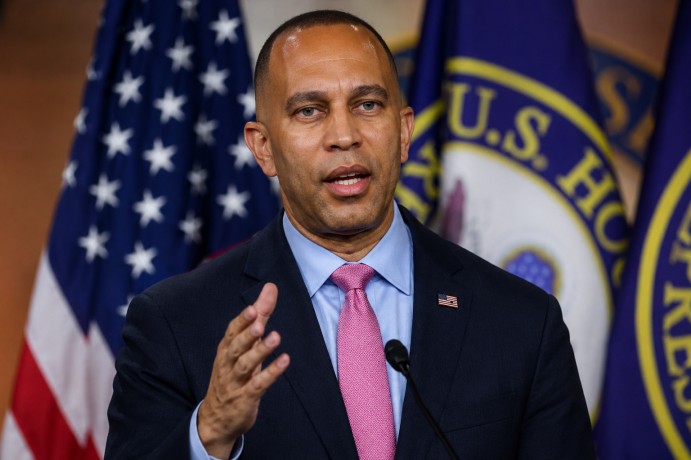
Senior Democrats in the House are gearing up to oppose a Republican-led proposal that aims to cut $3.3 billion in U.S. aid to Israel, exposing a rift within the Democratic Party regarding its stance on the nation. House Minority Leader Hakeem Jeffries has voiced his intention to vote against the amendment brought forward by Republican Representative Thomas Massie, labeling it as “overly broad.” Jeffries expressed concerns that the measure could inadvertently impact humanitarian efforts and undermine strategies to counter militant groups such as Hamas and Hezbollah.
House Democratic Caucus Chair Pete Aguilar has also expressed opposition to the proposal but acknowledged the need for a reevaluation of U.S.-Israel relations. Aguilar suggested that Israel’s current policies have led to increased regional isolation, hinting at the complexities within the party regarding future diplomatic approaches.
On the other side, Congressional Progressive Caucus Chair Greg Casar has called on lawmakers to support the amendment, arguing that U.S. taxpayer funds should not support Israel’s military activities. Casar advocates for a revised Democratic policy concerning Israel and Palestine, reflecting mounting pressure from progressive lawmakers and voters for a shift in U.S. policy amid the ongoing conflict in Gaza.
This debate surfaces as the Democratic Party confronts growing demands for change in U.S. policy towards Israel, driven by both constituents and progressive factions within its ranks. The internal division highlights a broader conversation on how the U.S. should engage with Israel, particularly in light of the humanitarian and geopolitical challenges in the region.
Highlighting the complexity of the issue, Jeffries has called for a “major reset” in U.S.-Israel relations. While he affirms Israel’s right to exist, he also advocates for the establishment of a Palestinian state. Jeffries further suggested that future U.S. military assistance should be aligned with human rights standards and take into account Israel’s capability to bear more of its defense expenses independently.